Use cases
Rebadging without a photo session: ID-ware via Photo Collect

The ID-ware Group specializes in physical identity and access management. Through its PIAM Suite, the company offers OCMS credential management, access control, visitor and contractor management, as well as card personalization, hardware, and project services. Its customer base consists of industrial companies, universities, financial service providers, hospitals, and operators of critical infrastructure. The company participates in TISAX, and all its processes are certified to ISO 9001 and ISO 27001.
Alexander Biederer has been with ID-ware for about six years and previously spent many years in various sales positions in the same industry. As a result, he understands both perspectives: the needs of end customers and the actual work an integrator must perform on a project.
“We regularly use Photo Collect in partnership projects, such as one with a renowned Bavarian automaker. There, we had the opportunity to plan and implement ID card management. In this context, we also partnered with Photo Collect .”
First of all: Photos taken to the best of one's ability
Whoever integrates ID card systems is ultimately responsible for the card design. Not because it’s part of the scope of services, but because an ID card cannot be issued without a photo. ID-ware has been improvising in this area for years.
“Previously, this had been handled in a much less professional manner. Within the limits of our capabilities, we took photos—some of them even at the scene of the incident. That was really very convenient. It served its purpose, but ultimately, the goal is a high degree of automation, minimal effort, and maximum convenience for the customer.”
This is the most candid description of a problem that rarely appears in requests for proposals. The card, the card management system, and the access control system are specified in detail. How the 5,000 photos of individuals will be entered into the system is to be clarified “during the project.” In practice, this means scheduling meetings, arranging venues, contacting people, and retouching photos—unpaid work that falls on the integrator.
The Rebadging Project: Local Capturing, Photos in the Customer System
The automaker was not interested in individual new enrollments, but rather in a complete ID photo replacement. Rebadging projects represent the greatest challenge for any enrollment process: A large portion of the workforce needs a new, valid photo within a specified time frame, and the rollout date is already set before the first photo is available.
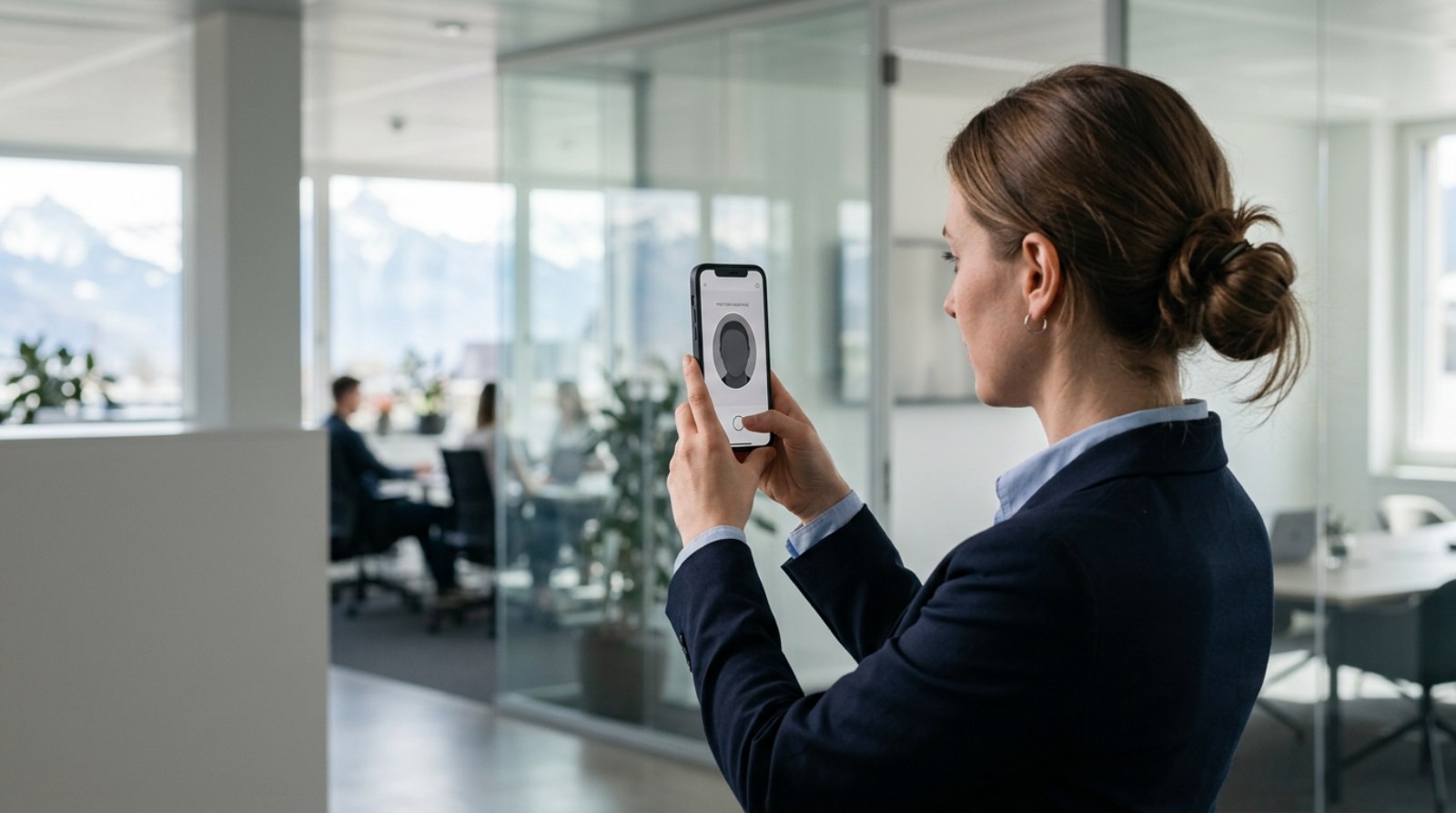
Capturing transferred the ID-ware to Photo Collect for this purpose, and the completed images were immediately imported into the customer’s system. Among other things, the photo kiosk was used—an on-site, offline self-service station. This channel is suitable for all employees at the plant who either do not have access to a work email address or whose smartphones are not permitted in the production area. Where possible, the Capturing is accessed simultaneously via a personalized link on the employee’s own cell phone, without an app and without logging in.
The process behind it remains the same in both cases: upload, AI validation of sharpness, lighting, head position, and background; manual quality check; cropping; and background replacement. The card management system ultimately receives a print-quality image that complies with ICAO and ISO standards. In the same run, existing legacy data can be checked and standardized, eliminating the need for a complete re-entry of existing photo databases.
To put the effectiveness of the automatic preliminary check into perspective: In practical terms, it yields about five times as many immediately usable images as an unprocessed upload. When rebadging several thousand people, this aspect is crucial to meeting the deadline.
Why automation serves as a selling point here
An integrator sees photo documentation not as a business opportunity, but as a risk. It is the step in the project that is the hardest to plan and most likely to get out of control.
"If you can implement all of this on the fly, it's a huge advantage: It saves money and time and is extremely efficient."
The key point is where the effort goes. It is shifted to the customer not through the integrator, but largely through automation. The end customer sends out an invitation or sets up a kiosk; employees take care of the rest in less than two minutes, and the final approval rests with the customer. In industrial and manufacturing environments, this is the difference between a side project and a weeks-long photo campaign involving shift scheduling.
The Decisive Moment: The Project Meeting with the End Customer
Whether a partnership works out isn't clear at the time it begins, but only in hindsight.
“The collaboration was truly excellent. There was a very cooperative relationship between Photo Collect, ID-ware, and, of course, the end customer. Let’s keep it up, and I look forward to many more great and successful projects.”
"The best moment is when you look back on a project like this together with the client and learn that their feedback is also extremely positive: that the collaboration was very successful and the quality was outstanding."
The effectiveness of an ID card solution is not assessed on the day of the go-live, but rather based on the number of inquiries, complaints, and reprints that occur afterward.
What integrators can take away from this
The ID-ware case can be summarized in three points:
Capturing represents the only unstructured step in an otherwise controlled chain. The PIAM Suite, personalization, and access control have been specified and tested. The individual’s profile comes from an external source. Photo Collect is not a replacement for these components, but rather fills the specific gap mentioned and delivers the results via REST API, sFTP, or ZIP—with OpenPGP encryption upon request.
Rebadging requires the use of multiple channels simultaneously. There isn’t just one way to reach the office, the factory floor, remote locations, and third-party contractors. The app, the QR code, the kiosk, and the smartphone all run on the same platform and adhere to the same quality standards.
The end customer sees the benefit; the argument is intended for the partner. Whoever is responsible for procuring the photos gains trust within the project and reduces a potential cause for complaints. The article on IDENTA and the nearly 30,000 ID photos taken in a single workday illustrates how things work in a different partner model.
Those most affected are providers of card management and PIAM systems, integrators of access control and time-and-attendance solutions, card manufacturers, and suppliers to universities, public transportation agencies, and government agencies. All of them rely on the individual’s photo but do not benefit financially from it.
A Note on the Database
Images of individuals are considered data requiring special protection. For customers in the industrial, financial services, and critical infrastructure sectors, the data processing chain is an integral part of the procurement review. Photo Collect is operated in an ISO 27001-certified data center in Switzerland, with each customer receiving its own instance. The AI models were developed in-house; no foreign cloud services or generative AI are used. Faces are checked and cropped, but not modified. The same regulations apply to self-service kiosks as well, regardless of their location.
Become a Partner
If you’re consolidating ID and access systems, supporting rebadging projects, or producing ID cards—and if capturing photos currently involves effort that isn’t billed—let’s discuss what an integration might look like for your specific situation. In less than two minutes, you can use a test photo to experience for yourself what the process is like for your customers.
The three partner models—integration, sales, and brokerage—are described in more detail on the Partners page.

More articles