Legal & Compliance
WCAG AAA: Why Photo Collect Meets Photo Collect Highest Level of Accessibility—and What That Means for You


When a company collects photos of all its employees, there’s one requirement that’s often overlooked: the process must work for everyone —including people with visual impairments, motor disabilities, or cognitive impairments. This is exactly where WCAG compliance comes into play, and Photo Collect the strictest level, AAA.
In this post, we explain exactly what WCAG AAA means, why this level is particularly relevant for a photo capture tool, and what tangible benefits it offers.
What does WCAG stand for?
WCAG stands for Web Content Accessibility Guidelines. These are the internationally recognized guidelines of the World Wide Web Consortium (W3C) for accessible digital content. They define measurable criteria to ensure that websites and web applications are usable by people with disabilities.
The guidelines are divided into three levels of compliance that build on one another:
- Level A – the minimum. Removes the most basic barriers.
- Level AA – the legal standard. Most regulations worldwide require this level.
- Level AAA —the highest and most stringent level. It includes additional, technically demanding criteria for maximum accessibility.
Each level includes the levels below it. If you meet the AAA criteria, you automatically meet the A and AA criteria as well.
Why AAA Is More Than AA
It’s worth taking a look at the reality here: Most legal requirements mandate Level AA. The European Accessibility Act, which will apply to public and private providers of digital services in the EU starting in June 2025, references WCAG 2.2 Level AA. Section 508 in the U.S. and EN 301 549 in Europe also require Level AA.
Level AAA, on the other hand, is considered demanding and is not recommended by the W3C itself as a general requirement for entire websites, because not every criterion can be implemented for every type of content. That is precisely why AAA is a true distinguishing feature: It is the level that hardly anyone achieves, because it goes beyond what is required by law.
Specifically, AAA means, among other things:
- Higher contrast ratios for text, so that everything remains legible even for people with low vision
- Larger click and touch areas for people with motor impairments
- the option to disable animations
- advanced control over visual presentation, such as line spacing and alignment
Why this is Photo Collect important for a tool like Photo Collect
A photo capture platform is not a traditional intranet used by just one team. When a company issues employee ID cards, government-issued IDs, or access cards, the entire workforce goes through the process—from trainees to executive management, and from people with perfect vision to those with severe visual impairments.
This has three practical consequences:
1. No one is excluded
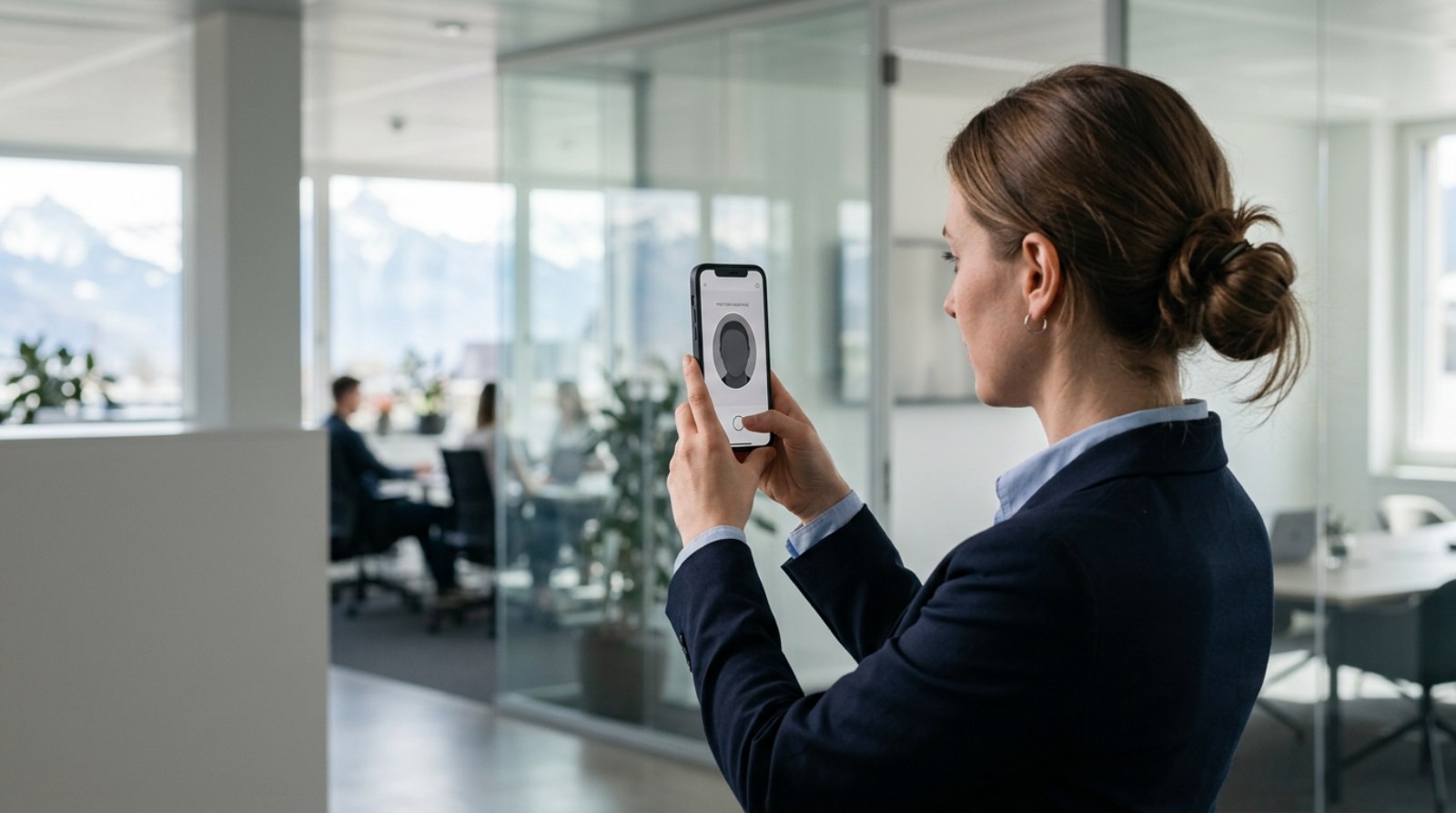
A standardized photo process is only truly standardized if everyone can actually use it. If a person with a visual impairment runs into trouble during the upload step, special manual workarounds are needed—exactly the kind of effort that an automated platform is supposed to eliminate. AAA compliance ensures that the self-service upload via smartphone—without an app or login—works for everyone.
2. Compliance Without Retrofitting
Photo Collect regulated industries: banking, government agencies, critical infrastructure, and pharmaceuticals. In these very environments, accessibility is not just a “nice-to-have,” but increasingly a prerequisite for procurement. Those who purchase software that already meets AAA standards do not have to worry about compliance later on if the legal framework becomes more stringent. This fits seamlessly with the other compliance features, ranging from GDPR and CH-DSG-compliant processes to data processing conducted exclusively in Switzerland.
3. Improved usability for everyone
Accessibility isn't just for a minority. Clear contrasts, large control areas, and minimal animations improve the user experience for everyone—whether using a smartphone in direct sunlight, on an old screen, or with a shaky hand at a photo kiosk. Features designed for accessibility benefit the entire workforce and thus directly contribute to Photo Collect low re-upload rate and high throughput.
Accessibility as Part of the Swiss Standard of Care
Photo Collect developed and operated by Visible Solutions in Zurich and hosted in an ISO 27001-certified Swiss data center. Its AAA compliance aligns with the same philosophy as Swiss hosting and the company’s proprietary AI: it’s about reliability that goes beyond the bare minimum.
While many providers operate at the legal minimum (AA), Photo Collect goes Photo Collect step further. This isn't a marketing claim, but a technical feature that can be verified.
WCAG AAA is the highest level of digital accessibility and is rarely achieved in practice. For a tool that guides an entire workforce through the same photo process, this is precisely what matters: A process that works for everyone requires no special solutions, meets the procurement requirements of regulated industries, and offers all users a noticeably better user experience.
Consistent photos. In minutes. Accessible to everyone.

More articles